AI title generators have transformed how content creators approach blog titles, YouTube titles, and content writing headlines. Finding the right long-tail keywords to feed into these tools can mean the difference between a headline that earns clicks and one that disappears into search engine obscurity. Long-tail keywords, those three-to-seven-word phrases with clear intent, give AI title tools the specificity they need to produce truly targeted results.
Whether you write blog posts, produce videos, or manage marketing campaigns, understanding which keyword phrases perform best will sharpen every title you create. This guide walks you through a practical, step-by-step process for identifying, validating, and using long-tail keywords that make your AI-powered title generator produce its best work. By the end, you will have a repeatable system for generating title ideas that rank, attract attention, and convert readers into loyal followers.
Key Takeaways
- Long-tail keywords with four or more words convert 2.5 times better than generic short keywords.
- Pair intent-rich modifiers like "best," "how to," and "for beginners" with your core topic.
- Use free tools like Google Autocomplete and AnswerThePublic before investing in paid platforms.
- Test keyword variations inside your AI title generator to compare output quality side by side.
- Refresh your long-tail keyword list quarterly to capture emerging search trends and seasonal interest.
Step 1: Understand Why Long-Tail Keywords Matter for AI Titles
Short, broad keywords like "blog titles" or "YouTube titles" carry enormous competition. Millions of pages target those exact phrases, making it nearly impossible for new or mid-sized creators to rank. Long-tail keywords flip this dynamic. A phrase like "best ai blog title generator for travel writers" targets a precise audience with clear intent, which means less competition and higher click-through rates from search results.
When you understand how AI title generators create better blog titles, you see they rely heavily on the input you provide. A vague prompt produces vague output. A specific long-tail keyword gives the AI context about audience, format, and topic, resulting in headlines that feel custom-written rather than generic. Think of the keyword as the blueprint; the AI is the architect building on top of it.
Search Intent and Specificity
Search intent falls into four categories: informational, navigational, transactional, and commercial investigation. Long-tail keywords naturally signal intent. "How to write catchy YouTube titles with AI" is clearly informational. "Best AI title generator pricing 2025" is commercial. When your keyword already communicates what the searcher wants, the AI tool can match that intent with appropriate title structures, whether that is a listicle, a how-to, or a comparison.
Specificity also helps you avoid the trap of keyword cannibalization. If you target "AI title ideas" across five different blog posts, those pages compete against each other. But targeting "AI title ideas for SaaS landing pages" in one post and "AI title ideas for cooking blogs" in another creates distinct content that Google can rank independently. Precision at the keyword level translates directly into precision at the title level.
Write down three audience segments you serve, then brainstorm long-tail keywords specific to each segment before opening any tool.
Step 2: Research Long-Tail Keywords Using Free and Paid Tools
Free Research Methods
Google Autocomplete remains one of the most underrated keyword research tools available. Type your seed keyword into Google's search bar, then note every suggestion that appears. For example, typing "AI blog title" might surface "AI blog title generator free," "AI blog title ideas for beginners," and "AI blog title examples for tech." Each suggestion represents real search behavior from actual users. Copy these into a spreadsheet and repeat with variations of your seed term.
AnswerThePublic visualizes questions people ask around a keyword. Enter "title generator" and you will see dozens of question-based long-tail phrases organized by who, what, when, where, why, and how. These questions make excellent foundations for content writing titles because they mirror the exact language searchers use. Google's "People Also Ask" boxes offer a similar goldmine, and you can expand each question to reveal additional related queries in real time.
Free tools provide volume estimates that are directional, not exact. Use them for idea generation, then validate with paid tools if budget allows.
Paid Tool Recommendations
Ahrefs, Semrush, and Mangools (KWFinder) all offer long-tail keyword databases with monthly search volume, keyword difficulty scores, and click-through rate data. Ahrefs is particularly strong for discovering keywords your competitors rank for but you do not. Export their top-ranking pages, filter for titles containing your seed terms, and identify gaps. You can often find dozens of untapped long-tail phrases this way.
These paid platforms also show you trending keywords, which is valuable for creators producing YouTube titles or timely blog content. A keyword that jumped from 200 to 2,000 monthly searches in the past quarter signals rising interest you can capitalize on. Combine trending data with evergreen long-tail phrases to build a balanced keyword portfolio that performs across seasons. If your niche involves data-driven content, similar research principles apply in fields like real estate API development, where targeted long-tail keywords drive qualified traffic.
Step 3: Categorize and Prioritize Your Keyword List
Intent-Based Grouping
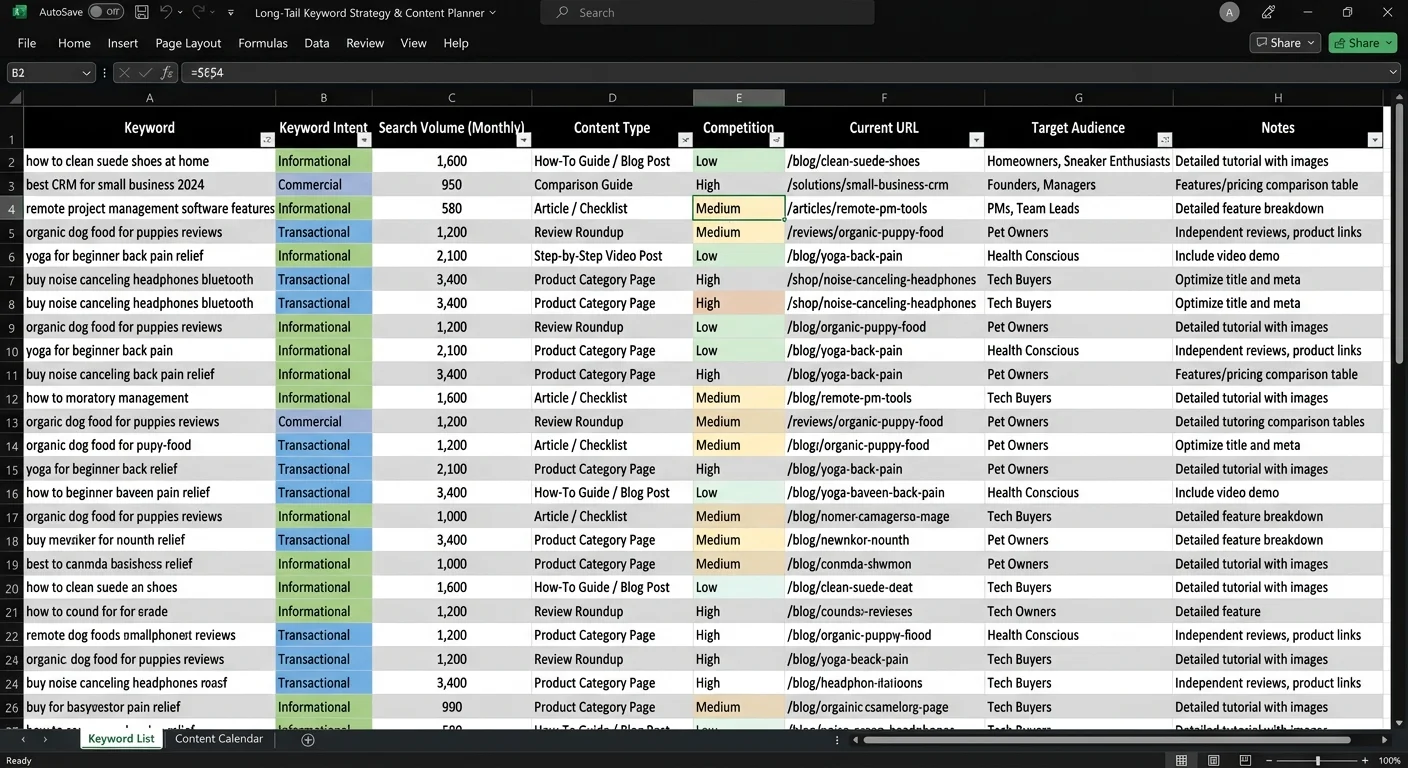
Once you have collected 50 to 100 long-tail keywords, the next step is sorting them into categories. Group by content type (blog titles, YouTube titles, social media headlines, ad copy), by intent (informational, transactional), and by difficulty. This structure prevents overwhelm and helps you plan which keywords to target first. A simple spreadsheet with columns for keyword, volume, difficulty, intent, and content type works perfectly.
| Keyword Example | Monthly Volume | Difficulty (1-100) | Intent | Content Type |
|---|---|---|---|---|
| ai blog title generator for beginners | 590 | 22 | Informational | Blog Post |
| best youtube title ideas ai tools 2025 | 480 | 31 | Commercial | YouTube Video |
| how to write seo titles with ai | 720 | 28 | Informational | Blog Post |
| ai title generator vs manual writing | 320 | 18 | Informational | Blog Post |
| free ai content writing title tool | 410 | 35 | Transactional | Landing Page |
| catchy ai generated youtube titles | 260 | 15 | Informational | YouTube Video |
Prioritize keywords that sit in the sweet spot: moderate monthly volume (200 to 2,000 searches) and low difficulty (under 35). These are realistic targets for most content creators and marketers. High-volume, high-difficulty keywords like "best AI writer" may seem attractive, but ranking for them without significant domain authority is a multi-year project. Low-difficulty long-tail phrases can start driving traffic within weeks of publication.
Also Check: How Keyword Ranking Impacts Domain SEO Strength
"The best long-tail keyword is one your audience actually types, not the one with the highest search volume."
Also consider your existing content. If you have already published a post comparing AI title generator vs manual writing, targeting closely related long-tail keywords in a new piece would create topical authority. Internal linking between these related posts strengthens both pages in Google's eyes, and readers benefit from a connected content experience that answers multiple related questions.
Review your list monthly and archive keywords that have stagnated or dropped below meaningful volume. Keyword trends shift, especially in the AI space where new tools and features launch constantly. A keyword that performed well six months ago might now face much stiffer competition. Treat your keyword list as a living document, not a static reference.
Avoid targeting multiple pages for the same long-tail keyword. This causes cannibalization and confuses search engines about which page to rank.
Step 4: Feed Keywords Into Your AI Title Generator for Maximum Impact
Prompt Engineering Tips
The way you input long-tail keywords into an AI title generator directly affects output quality. Rather than pasting a raw keyword, frame it with context. Instead of entering "ai blog title ideas for fitness," try "Generate 10 blog title ideas targeting the keyword 'ai blog title ideas for fitness,' aimed at personal trainers who blog weekly." The additional context about audience and frequency gives the AI enough information to produce titles that resonate with that specific reader persona.
Experiment with different modifier words attached to your long-tail keyword. Words like "ultimate," "step-by-step," "proven," and "mistakes" trigger different title structures from AI tools. Running three to five variations of the same base keyword through your generator produces a wider range of options, and you can cherry-pick the strongest. This approach works equally well for YouTube title ideas from AI tools and for blog headlines, since the underlying principle of specificity applies across formats.
Once you have generated a batch of titles, score them against three criteria: keyword inclusion (does the long-tail phrase appear naturally?), emotional pull (does it create curiosity or promise value?), and length (is it under 60 characters for blog SEO or under 70 for YouTube?). This scoring framework eliminates guesswork. You might also A/B test two title variations on the same piece of content to gather real performance data over time.
Learning how to use AI for content writing title optimization becomes much easier once you have a strong keyword foundation. The tool does the creative heavy lifting, but you supply the strategic direction. Think of long-tail keywords as the GPS coordinates for your content. Without them, even the most sophisticated AI will wander. With them, it arrives at a title that speaks directly to the person searching for exactly what you offer.
Save your top-performing title prompts as templates. Swap in new long-tail keywords each time to maintain consistency while scaling output.
Frequently Asked Questions
?How do I feed long-tail keywords into an AI title generator effectively?
?Is Google Autocomplete good enough, or do I need a paid keyword tool?
?How often should I update my long-tail keyword list for AI title prompts?
?Can using the same long-tail keyword across multiple blog posts hurt rankings?
Final Thoughts
Long-tail keywords are the foundation that makes AI-generated blog titles, YouTube titles, and content writing headlines actually work. Without specific, intent-rich keyword inputs, even the best title generator produces mediocre results. Follow the four steps outlined here: understand why specificity matters, research keywords with the right tools, categorize and prioritize ruthlessly, and then feed those keywords into your AI tool with proper context. This system is repeatable, scalable, and gets better every time you refine your keyword list based on real performance data.
Disclaimer: Portions of this content may have been generated using AI tools to enhance clarity and brevity. While reviewed by a human, independent verification is encouraged.